Case study · AI orchestration · Evaluation
How to measure and build AI repeatability
Same input, same-ish answer from AI, every time. A bit tricky in practice.
How ReLoop.me got the same role type 30 times in 30 runs, cut pay spread on the same CV from 34% to 4%, and published where it still drifts.
By Ligia Adam ·
Key terms
- AI repeatability
- How consistently an AI system returns the same conclusion when it gets the exact same input again, measured by running that input many times and comparing every output field. Also called AI or LLM consistency.
- AI drift
- Variation in an AI system's output that has nothing to do with its input: the same CV, a different seniority tier. Measured as output variance across repeat runs. Also called LLM drift.
- Probabilistic vs deterministic
- A language model predicts the likeliest answer, so it can vary from run to run (probabilistic). A rule or a lookup table returns the same answer every time (deterministic). Reliable AI systems use the model only where judgement is needed.
- Capability intelligence
- Reading the capability inside a CV or a job description: claims versus evidence, the skills mix, seniority and market value. The category ReLoop.me works in.
The challenge: you usually don’t get the same answer twice from AI
First, some context
ReLoop.me reads between the lines of CVs and job descriptions to reveal the overall shape and form of the professional capability mix underneath. We call that capability intelligence (as revealed by Profile Intel and Role Intel, the two flagship products), which covers things like role classification, seniority grading, operating type, transferability, and market value signals.
The problem?
Well, AIs are inherently probabilistic.
Which means that artificial intelligence makes predictions, decisions, or generates outputs based on probabilities and statistical patterns rather than fixed, rigid rules. Which is fine for most things, but when it comes to complex work or a very distinct career journey, you’d like it to be understood in its complexity, despite the odds.
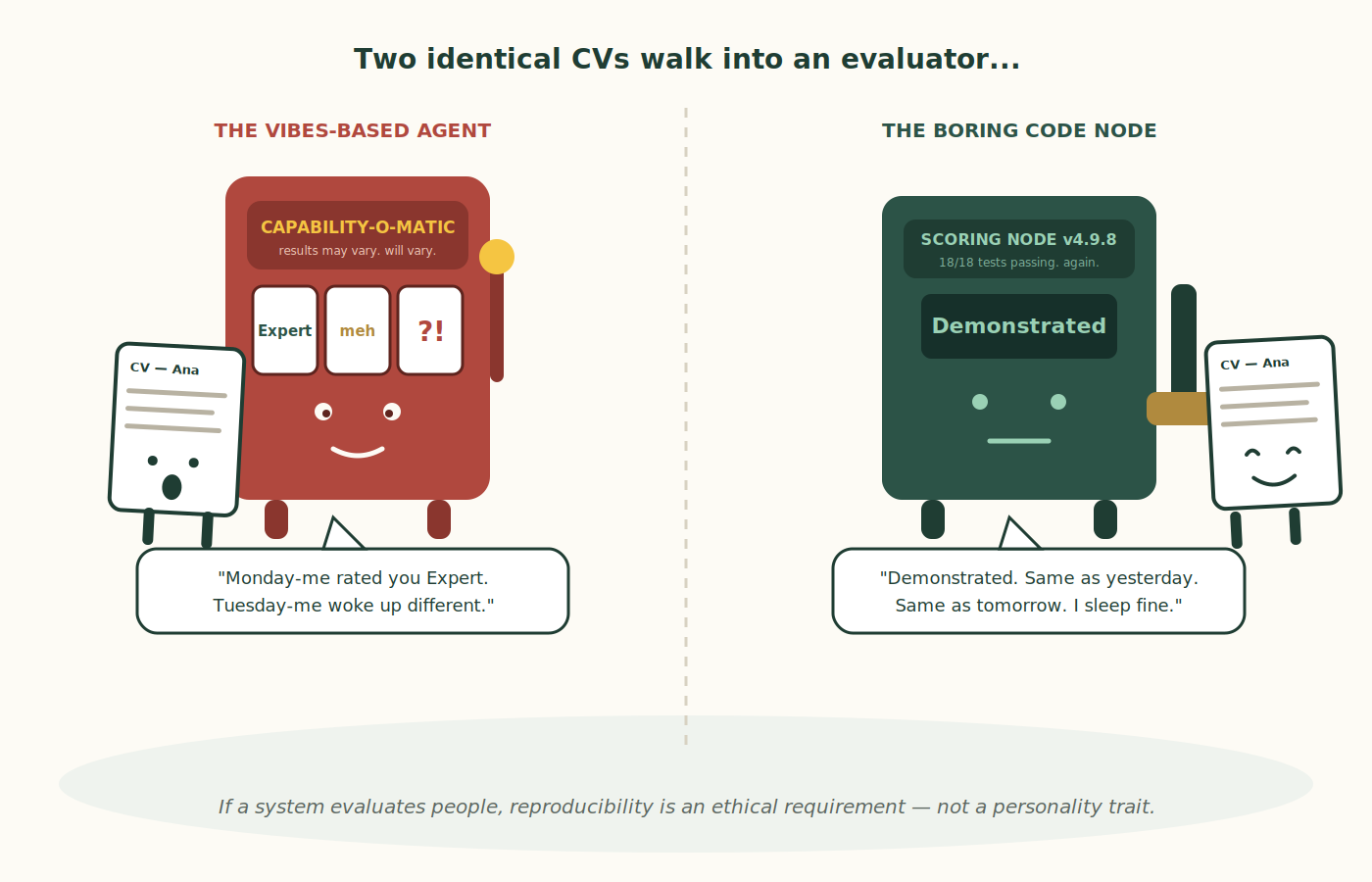
If you ask any AI to evaluate the exact same CV twice, it will use different words to tell you different things. Even when you ask for specifics, like seniority level or a salary estimate, it can return wildly different results. And that applies to almost any domain, or tool that is AI-powered.
A response that slightly changes each turn cannot support a real decision.
And in a tool like ReLoop.me, when people rely on an assessment to negotiate a salary or evaluate talent, that really matters.
So, in order to make ReLoop.me reliable enough, and already making active efforts to stop wrong AI answers before they reach users, we first needed to measure how often the engine gave the same verdict twice. So we could fix the parts that caused the drift.
The solution
What we built
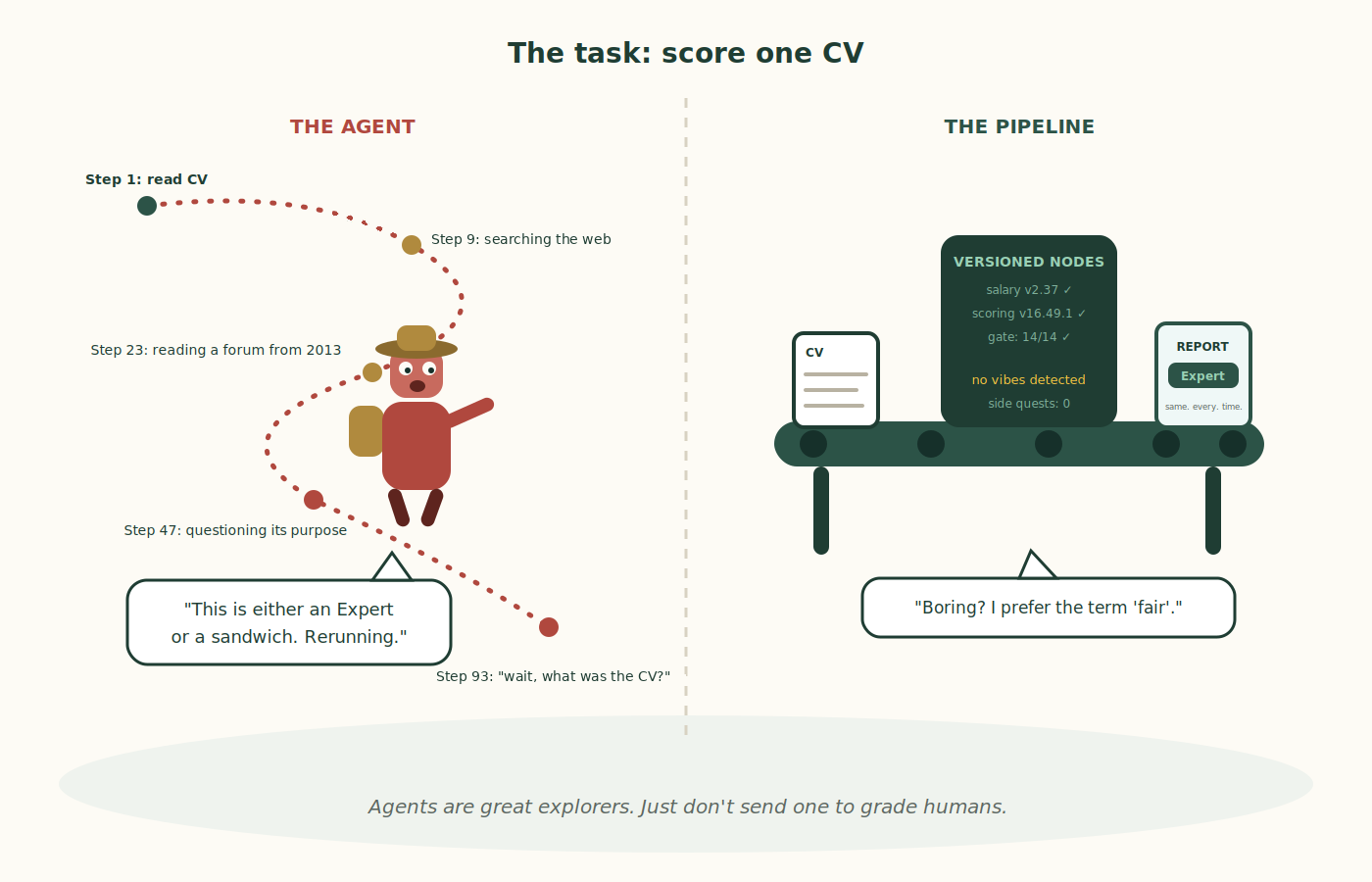
In a nutshell, the solution was a fixed, structured, personalized and proprietary system of rules.
A fixed, standardised vocabulary
When asked, AI uses a lot of different words to refer to the same thing.
So we replaced open-ended AI labelling with a strict taxonomy: seven role types, a single standardised seniority ladder, and explicitly defined capability levels that the model must map to, rather than invent.
Choosing and settling on the final vocabulary inside ReLoop.me meant a side quest of deeper research across a wide range of topics, ranging from psychology to HR to social sciences, math and all that. Eventually, the fixed vocabulary became a key part of the engine's proprietary framework, and it is anchored in published classifications, such as the European Commission's ESCO skills taxonomy and the EQF qualification levels, rather than in labels the model invents.
Pre-determined (deterministic) and calculated pay logic
AIs work best with data and numbers.
It’s really good at estimating how much money a junior person with no prior experience should earn, or the compensation value for a specialized line work, based on published data sets it can feed on. And mostly, that’s good enough.
But in ReLoop.me we approached capability market value differently.
A key feature inside the ReLoop.me products is that they also offer an estimate of what the market value for a person’s specific set of skills is (or what a very complex job should really be paying).
AIs are good at guessing, but they can also be REALLY off when they lack the data.
So we decoupled compensation figures from generative guessing.
Inside ReLoop.me, pay estimates are pulled programmatically from structured lookup tables indexed by role family, location and seniority tier, each explicitly labelled as Calibrated or Estimated. This way, the deterministic part works across nonlinear careers as well.
For tailored, not averaged measures.
An automated AI drift test
Drift is common with AI. But what is drifting also needs constant monitoring, especially when it can affect the rest of the moving pieces inside a system.
So we built an internal, automated evaluation set that runs the exact same CV or job ad through the pipeline 8 to 30 consecutive times, and programmatically compares the outputs to measure AI drift across every field.
This helps with internal calibration and continuous improvement.
Radical transparency, via a public methodology page
At ZORRI, we believe AI governance needs human accountability.
So we build in public our own products, and we publish the results of the repeatability tests we run in the open, including where variance still occurs. Learn more at reloop.me/methodology.
Results
Here are some of those internal test results, in the open.
Self-run repeat-run tests on production settings, 1 October 2026:
one CV and one job ad, 30 runs each, against two general-purpose AI models.
Published at reloop.me/methodology:
- 30 / 30role type, identical on the CV and on the job ad
- 30 / 30CV seniority, identical. The two commercial AI models shifted verdict in 6 and 3 of 30 runs
- 93%of job-ad capabilities kept the same band across repeat runs, against 87% and 92% for the two general-purpose AI models
And our own engine’s results, which is AI-powered, but also kept in check by rules:
Role Quick Check (aka the core engine of Role Intel)
matched the expected answer in 24 of 24 runs on a fixed set of 12 job ads in October, and in 23 of 24 reads in the November re-test (ReLoop.me Benchmark Notes No. 1).
Profile Intel:
Capability Interpretation for real, not taking for granted what people claim in their CV:
Profile Intel mirrored the professional labels a CV gave itself, where they didn’t fit the rest of the resume, in 0 of 8 runs, against 4 to 8 of 8 runs for commercial AIs.
Post-calibration improvements
Internal remeasurement on synthetic CVs, 21 November 2026:
- Pay spread on the same CV: reduced from 34% to 4%.
- Seniority stability against title inflation: stable in 3 of 3 runs. Changing a job title alone no longer moves the assessed seniority level.
- Resistance to framing bias: adding outside recruiter context shifted pay estimates by just −0.9%, down from +17%.
What still varies inside the ReLoop.me engine
Running a live, AI-powered system means constantly adapting to change.
A lot of things vary, and we found it's best to keep checking.
The most recent tests show that, on genuinely ambiguous job ads, seniority grading and which of two role types leads can still vary between full runs.
Natural-language phrasing also shifts from run to run: the wording of a capability changes even when its level and band hold. That's why the methodology page advises leaning on the level and band, not the exact phrase.
Both limitations are documented openly on the methodology page, and we're working on them.
What a ZORRI client gets
If your AI workflow produces inconsistent classifications, scores or numbers across identical inputs, better prompting alone will not fix it.
The ZORRI repeatability method
- Measure. Run the same input 8 to 30 times and compare every field.
- Fix the vocabulary. Give the model a closed set of labels to map to.
- Calculate, don't generate. Move numbers and rules out of the model into tables and code.
- Publish. Show the results, including what still varies.
- Monitor. Re-run the test after every change, so drift can't come back unnoticed.
ZORRI brings this method, built for ReLoop.me, to your production pipelines:
- A custom repeat-run test harness, tailored to your AI workflow, to benchmark baseline variance across identical inputs
- A plain-English audit report on which outputs are stable, which drift, and why
- Structural stabilisation fixes: fixed vocabularies, deterministic lookup tables and schema-constrained outputs, to turn probabilistic guesses into repeatable business logic
Built for any workflow where inconsistent AI verdicts erode customer trust or operational reliability. See the AI Workflow Audit.
Sources: ReLoop.me repeat-run test, 30 runs × 3 arms per product, 1 Oct 2026 · reloop.me/methodology (read 27 Nov 2026) · methodology briefs log, 5 Oct 2026 · ReLoop.me Benchmark Notes No. 1, Nov 2026 · internal remeasurement on synthetic CVs, 21 Nov 2026 · stack: Claude API, n8n, Airtable, Supabase, Netlify · built independently, AI-assisted.