Case study · AI orchestration
How to stop wrong AI answers before they reach users
Case study on the automated, fail-closed quality control built for ReLoop.me.
By Ligia Adam, founder of ZORRI ·
Key terms
- AI quality control
- The checks an AI output passes before anyone sees it: rules that test its logic and structure, a second reviewer, and a gate that can stop it. It is how a production system keeps hallucinations, contradictions and invented figures away from users.
- Fail-closed AI system
- A system that holds an output when a check fails or returns no verdict, instead of sending it anyway. When in doubt, nothing ships.
- Human in the loop
- A person decides what happens to an output the checks stopped, instead of the system re-running it until something passes.
- Independent AI reviewer
- A second AI model, with no memory of the one that wrote the draft, that scores the draft and returns specific corrections.
The challenge: AI getting it “mostly right” isn't good enough
First, some context
ReLoop.me is an AI-powered platform that reads the actual professional capability inside a CV or a job description.
It looks at it in perspective and between the lines, to give you the bigger picture, delivering its capability intelligence either as a complex report (for B2C) or as a comparable data set (for B2B).
It's essentially built to follow the human logic of an experienced recruiter or domain specialist, on AI steroids, and give you a neutral perspective of what's truly there, skills-wise, across domains and geographies. It tells you things like:
- what's actually demonstrated (in a CV) or needed (in a job ad), versus the initial claims
- the specific combo-mix of skills evidenced by a specific CV or job description
- the estimated market value for a specific role or profile: calculated, not averaged
ReLoop.me is designed specifically to recognise and interpret the complexity of skills and capabilities of professionals with nonlinear careers, and to support fair reviews and teams committed to skills-based hiring.
How it works
- Submit: a user submits a CV or job description
- Read: a multi-step, rules-enforced AI engine reads it
- Deliver: a structured report is emailed
Profile Intel for a CV, Role Intel for a job description.
People and companies usually use these reports, or the calibrated data, for career and salary decisions.
The problem?
A wrong AI-generated report does more damage than a late one.
AIs are probabilistic.
They hallucinate, drift, invent, ignore, inflate, flatter, or contradict their own assessment.
You can't really send raw AI interpretation to users unchecked. Not ethical. Or valuable.
And checking it by hand can't scale well.
The solution
What we built
Six layers, in the order a report meets them. We call it the ZORRI fail-closed architecture:
- Input guards: stop broken or blank inputs before any tokens are spent
- Rule checks: test the logic and structure of the AI read
- Independent AI reviewer: a second model scores the draft and returns corrections
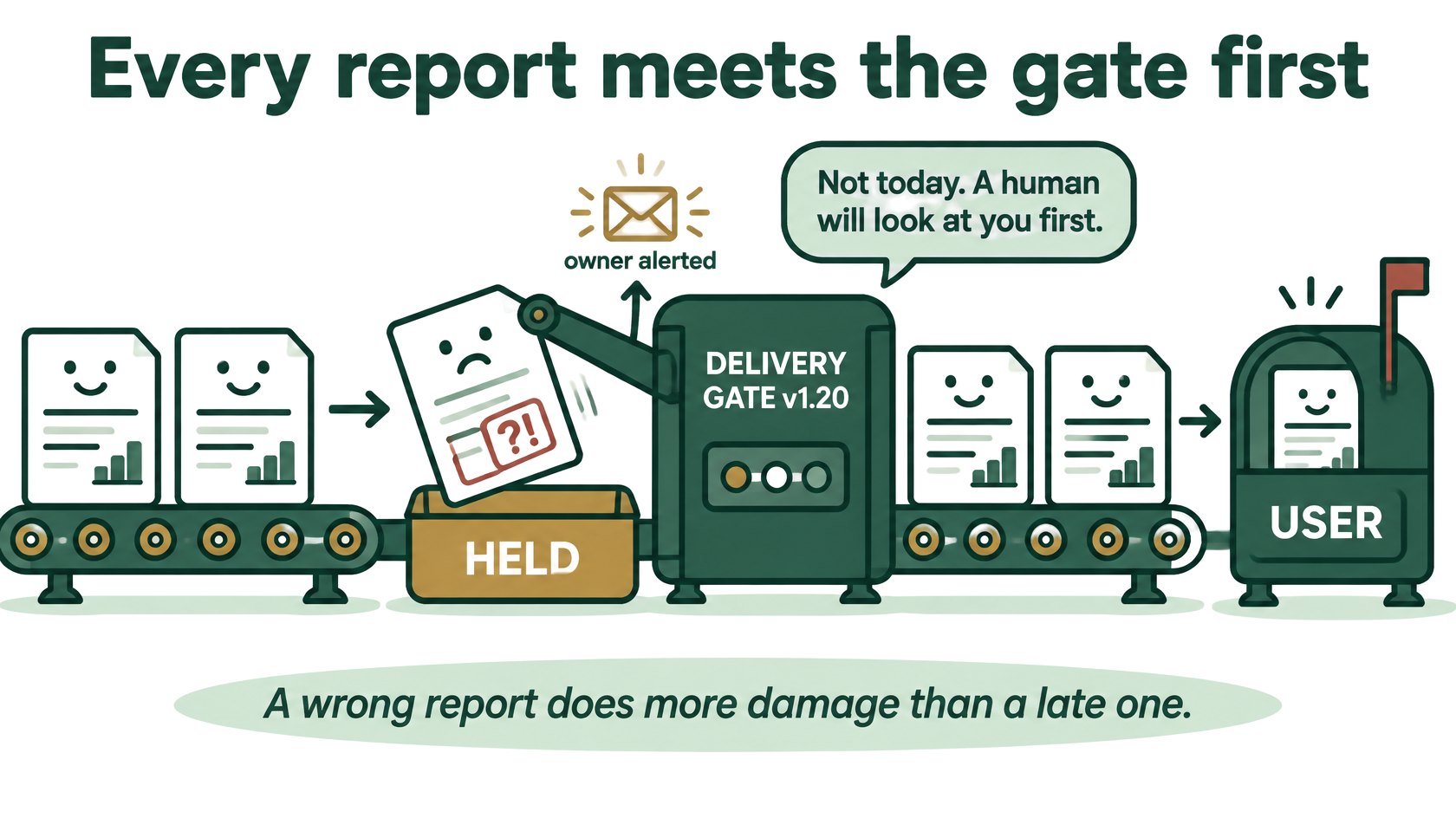
- Delivery gate: any failed check, or no verdict, holds the output
- Human escalation: the owner is alerted and decides
- Versioned rollback: every change can be undone in one step
Checking what comes in: the input guards
AI feeds on the data it receives, but even AI can fail to read some data.
The input guards, a cost guard and an empty-input check, stop broken or blank uploads before any API tokens are spent. (Live on Profile Intel.)
Checking what is in: the rule checks
The rules validate the scoring-band logic, the claims-versus-evidence audit and the report structure.
Each rule was added specifically to better steer AI into getting it right, every time.
The smart re-check: a distinct AI reviewer of the AI layer before it
A separate AI, with no memory of the one that wrote the read, scores the draft and returns specific corrections, with its reasoning.
The corrections are merged and enforced in the following layers, before a report is actually delivered.
The internal safe space for failure: if AI fails, delivery is blocked
If one of the checks along the route fails, for any reason, or if the AI reviewer returns no verdict on key aspects, the report is held internally.
The owner is alerted that the report needs manual review, so the human in the loop steps in, and nothing reaches the user.
In AI engineering, this is called a fail-closed delivery gate.
Continuous improvement: versioned nodes with rollback
Each new rule, new blocker or new drift is recorded and fixed, so the engine is continuously updated.
Every production change records the version it replaces, so it can be reversed straight away if quality drops.
The ZORRI reliability principles
Like a ReLoop.me report, the engine tilts a certain way on purpose. Three principles, and why:
- Late over wrongA held report costs a few hours. A wrong one costs a career or salary decision, and the user's trust.
- A person over a retry loopWhen a read fails, the owner looks at it. Re-running until something passes would hide the reason it failed.
- Rollback over a hotfixEvery change can be reversed straight away, so a bad release is undone first and fixed second.
Result
Nothing in ReLoop.me ships as raw AI output, and every production change has a named rollback path.
Figures from the live engine, as of 23 November 2026:
- 573reads produced, 14 June to 21 November 2026: 324 Role Intel and 249 Profile Intel, test runs included
- 12Role Intel reads held by the gate and logged, 3 October to 12 November 2026, each one stopped before anything was stored or emailed
- 34% → 4%spread of the pay estimate on the same CV across repeat runs, before and after a stability fix (synthetic CVs, 21 November 2026)
What the ReLoop.me gate held, and why
| Reason | Stage | Held |
|---|---|---|
| The report copied 10 or more words verbatim from the job ad | Delivery gate | 4 |
| A hiring number (applicants, time to fill, tenure) reached the report | Delivery gate | 3 |
| The reviewer returned no delivery verdict, so the gate treated it as a fail | Reviewer merge | 2 |
| The reviewer listed a blocker | Reviewer merge | 1 |
| The original read couldn't be parsed | Reviewer merge | 1 |
| The input was a programme overview, not a single role | Reviewer merge | 1 |
How this works in action
Once, the reviewer step broke on quoted text in a German job ad.
The gate held the read instead of sending a broken one, and the fix was proved on a staging copy of the workflow before release.
Checks need checks. In November 2026 the reviewer itself got one wrong: on a Profile Intel read it moved management experience onto the individual-contributor ladder, which priced the profile too low.
The fix wasn't a better-worded reviewer. It was a rule above it: the reviewer can no longer change a seniority track, only flag it.
The checks also catch structural and logic errors. They don't make AI infallible.
That's why held reports go to a person, and every change can be rolled back.
What a ZORRI client gets
ZORRI builds and recommends AI workflow automation running on the same architecture:
- Defined checks at each critical step of your product logic
- An independent AI reviewer, isolated from the model that produced the output
- A fail-closed gate that stops errors internally, with human-in-the-loop alerts, so recurring errors are caught early and the system improves over time
For any workflow where a wrong AI answer costs user trust or revenue.
What is different: the checks aren't promised, they're logged. Every hold above has a date, a stage and a reason, and the architecture runs in production on ReLoop.me today.
The logic travels
ReLoop.me was one specific use case. It reads CVs and job ads, so its checks are about scoring bands, evidence and pay.
The ZORRI fail-closed architecture is not about CVs. Any AI product that hands people an answer can borrow it. Layer by layer:
| Layer | In ReLoop.me | In another AI product, for example |
|---|---|---|
| Input guards | Blank or broken CV uploads stopped before any tokens are spent | An unreadable scanned invoice bounced before the model runs |
| Rule checks | Scoring bands, claims versus evidence, report structure | Totals add up, required fields present, policy wording respected |
| Independent reviewer | A second AI scores the draft read and returns corrections | A second AI checks a support reply against the help centre before it's sent |
| Fail-closed gate | The report is held and the owner alerted | The reply, quote or summary waits for a person |
| Versioned rollback | Every node change records the version it replaces | Every prompt and rule change can be undone in one step |
Two ways to use it
- Inside the product you already have. The checks are built around the AI step you already run, the way they wrap ReLoop.me's engine. Start with an AI Workflow Audit to find where wrong answers get through.
- Custom-built, from day one. A new AI workflow designed with the guards, reviewer and gate in place before the first user sees it. That's the AI Orchestration Sprint.
Sources: ReLoop.me engine records (Role Intel and Profile Intel tables, Role Intel gate log), read 23 Nov 2026 · repeat-run remeasurement on synthetic CVs, 21 Nov 2026 · stack: Claude API, n8n, Airtable, Supabase, Netlify, GitHub, Cloudflare · built independently, AI-assisted.